
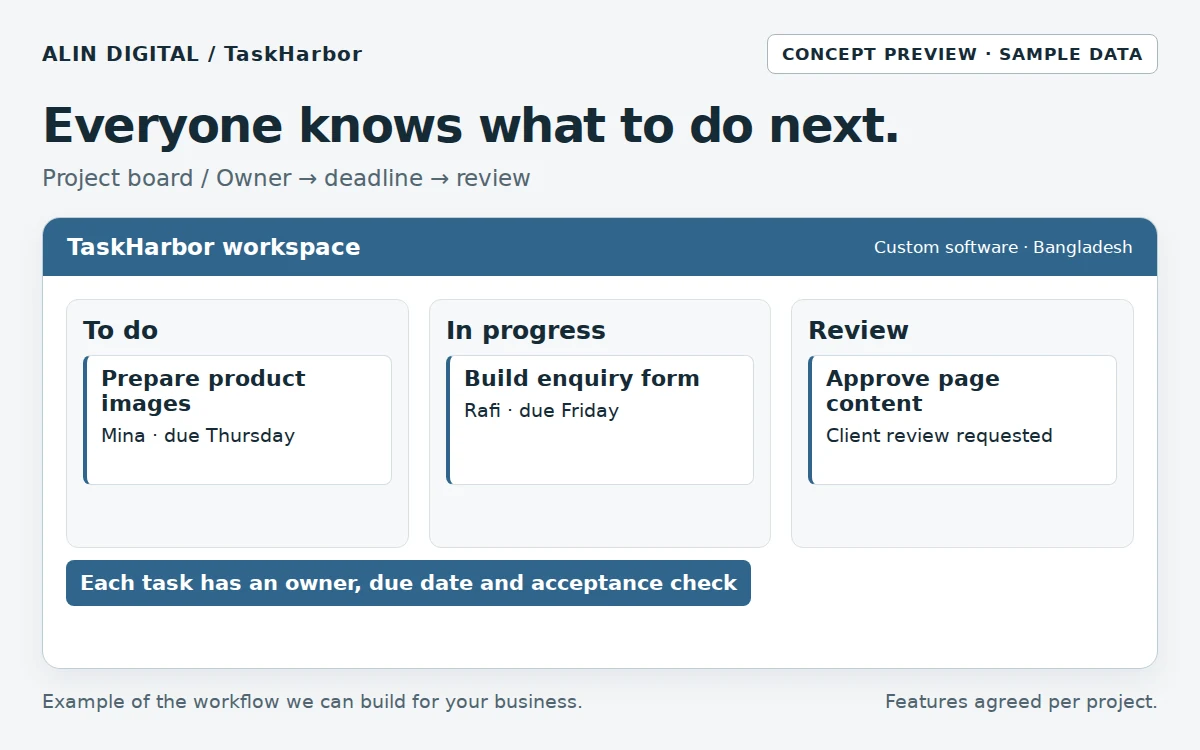
A task board fails when every card says “in progress” and nobody knows what is blocking delivery. Useful project software records a specific output, one accountable owner, a due date and an acceptance condition. A Bangladesh agency handling several client projects also needs to distinguish internal completion from client approval. Otherwise the team reports work as finished while the client is still waiting for a revision or missing file.
A familiar situation: illustrative example
Imagine a designer marks a task finished but the client still has to review it. The project board should show “awaiting review”, with an owner for the next step. Otherwise both sides may wait for each other.
Design the workflow before the interface
Write tasks as deliverables rather than vague activity labels. “Prepare three approved product images” is clearer than “work on design”. Record dependencies and a blocked reason. Give reviewers a defined next action. If feedback changes the original requirement, capture it as a change request instead of quietly adding it to an existing task.
Test the exceptions and boundaries
Choose a small workflow: planned, in progress, blocked, review and done. Limit unnecessary statuses and make the owner responsible for updating them. A manager should be able to identify overdue work without asking every staff member privately. Keep discussion attached to the relevant task so decisions do not disappear in a separate chat.
Choose the smallest workable solution
Pilot on one active project, including a late dependency, a rejected review and a reassigned task. Measure whether handoffs become clearer. Do not use a task count as a direct measure of individual productivity; tasks differ in difficulty and risk. Add client access only after permissions and internal-only comments are separated properly.
A practical workflow
- Agree a deliverable and acceptance condition
- Assign one owner and a due date
- Record dependencies and blockers
- Review against the agreed scope
- Close with files and handover notes
Acceptance checks before handover
Test a normal transaction, invalid input, a repeated request and an account without permission using representative business data. Check the agreed export. Write down account ownership, hosting responsibility, backup arrangements and the support route. Use test data before importing real customer records.
What to measure
Overdue handoffs; blocked time; rework reasons; accepted deliverables. Record a baseline before launch and review the pilot against it. Software cannot guarantee improvement if the operating process and ownership remain unclear.
What the proposal should include
Separate features, users, imports, integrations, training and support in the quote. Ask for a BDT proposal and confirm whether hosting, API usage and third-party subscriptions are included. Custom development is different from subscribing to an existing SaaS product. Agree delivery dates after discovery and technical checks; unresolved integrations make fixed promises unreliable.
Common questions
Do we need every feature in the first release?
No. Start with one complete, testable workflow. Add modules after real usage shows what is missing.
Can the business move its data later?
Agree export formats, file access and account ownership in the proposal, then open an actual export during acceptance.
Further reading and next step
Compare the service with your workflow: TaskHarbor · Project delivery · Software catalogue · Discuss the project.