
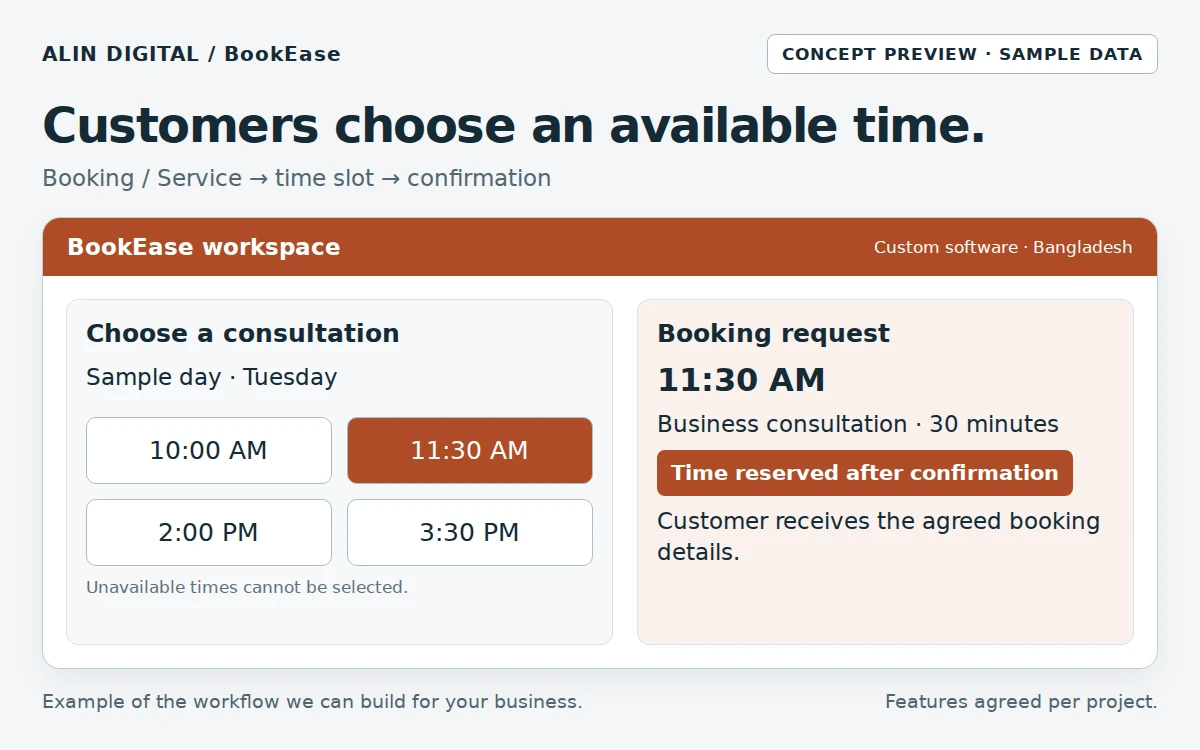
A booking form is not a reliable booking system if two people can reserve the same resource. For a salon, training centre or consultancy, define what is being reserved: a staff member, a room, a piece of equipment or a combination. Then define duration, preparation time and opening hours. Use Asia/Dhaka for the operating schedule and display confirmation details clearly so staff and customers interpret the same appointment time.
A familiar situation: illustrative example
Imagine a salon gets one booking by phone while another customer selects the same slot online. Both customers may arrive unless the resource is reserved in one shared system. That conflict is the core problem to solve.
Design the workflow before the interface
Separate a requested appointment from a confirmed slot. If staff must approve first, label it as a request. When a slot is confirmed, prevent competing submissions from both succeeding. Agree how staff block holidays, add a phone booking and change a duration without creating a clash. Test simultaneous requests, not only one happy-path booking.
Test the exceptions and boundaries
Reminders help only when contact details are correct and the messaging channel is authorised. Let customers understand cancellation and rescheduling rules before they submit. If deposits are required, payment success must be verified server-side through the agreed gateway. A screenshot or browser redirect alone should not mark an appointment paid.
Choose the smallest workable solution
Start with one location and a small service list. Review missed appointments, manual corrections and customer confusion. Advanced features such as multiple branches, resource combinations and recurring memberships should follow a stable core workflow. Do not collect health records in a general appointment tool unless that separate requirement has been carefully designed.
A practical workflow
- Choose a service and available resource
- Select a Dhaka-time slot
- Submit required contact details
- Confirm availability and any payment
- Allow controlled rescheduling
Acceptance checks before handover
Test a normal transaction, invalid input, a repeated request and an account without permission using representative business data. Check the agreed export. Write down account ownership, hosting responsibility, backup arrangements and the support route. Use test data before importing real customer records.
What to measure
Double-booking incidents; no-shows; manual corrections; reminder delivery. Record a baseline before launch and review the pilot against it. Software cannot guarantee improvement if the operating process and ownership remain unclear.
What the proposal should include
Separate features, users, imports, integrations, training and support in the quote. Ask for a BDT proposal and confirm whether hosting, API usage and third-party subscriptions are included. Custom development is different from subscribing to an existing SaaS product. Agree delivery dates after discovery and technical checks; unresolved integrations make fixed promises unreliable.
Common questions
Do we need every feature in the first release?
No. Start with one complete, testable workflow. Add modules after real usage shows what is missing.
Can the business move its data later?
Agree export formats, file access and account ownership in the proposal, then open an actual export during acceptance.
Further reading and next step
Compare the service with your workflow: BookEase · Appointments · Software catalogue · Discuss the project.