
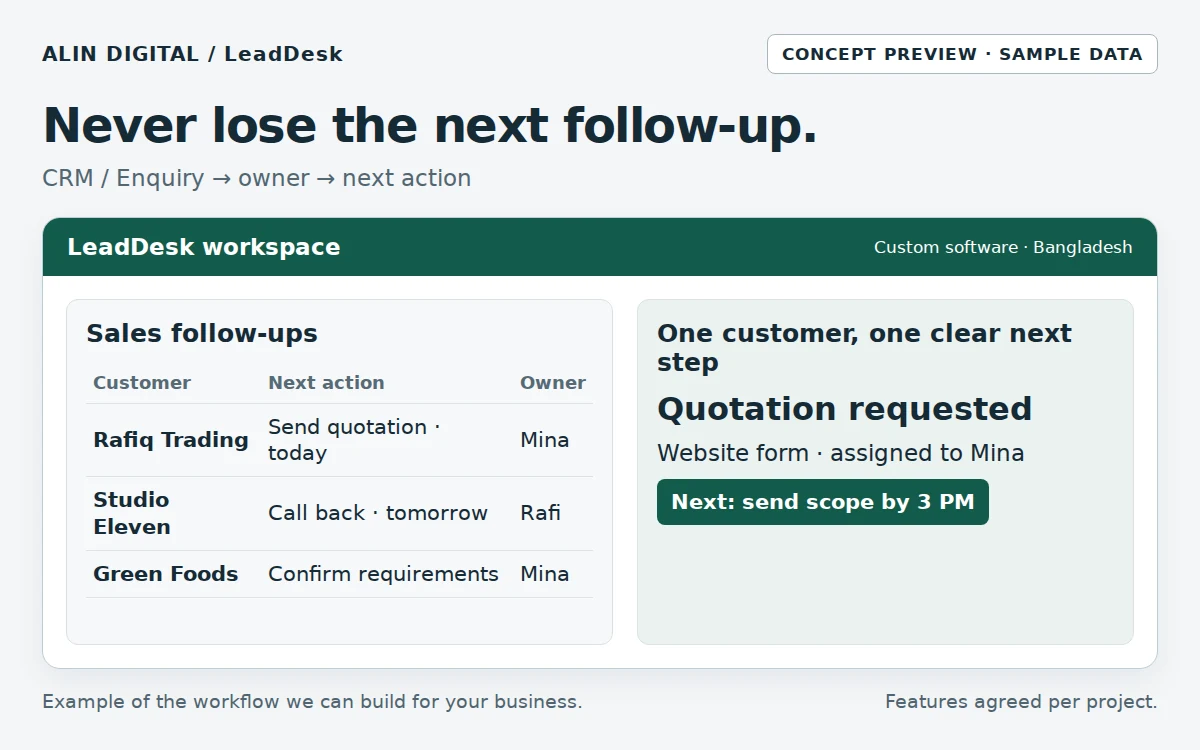
Enquiries disappear when several people reply from private phones and nobody owns the next action. A CRM should make the next step visible, not merely collect contact numbers. For a Bangladesh service business, start with the channels customers actually use: website forms, telephone calls, referrals and conversations that move to WhatsApp. Keep the original source even when a salesperson later edits a record. That lets the owner compare the quality of enquiries instead of assuming every channel performs equally.
A familiar situation: illustrative example
Imagine a small Dhaka agency: a customer asks for a quotation, the salesperson is away the next day, and nobody knows whether a reply was sent. The first useful CRM feature is simply a visible owner and next action. Fancy forecasting can wait.
Design the workflow before the interface
Define stages using observable events: new enquiry, requirement confirmed, quotation sent, decision pending and won or lost. A lead is qualified only when it meets your written criteria; a friendly chat is insufficient. Assign one owner and a dated next action. Record why a deal was lost without turning the form into a long questionnaire.
Test the exceptions and boundaries
Take a small, representative sample before importing the entire spreadsheet. Include duplicates, an incomplete phone number, a reassigned lead and a closed deal. Agree how these are handled. Managers should see pipeline totals; individual sales staff may need narrower access. Test permissions by signing in as each role, rather than trusting an administrator’s view.
Choose the smallest workable solution
A CRM is premature when nobody will maintain the records. A shared sheet with a clear owner can be the better starting point. Build custom software when existing tools leave a specific, costly workflow unresolved. Document exports and account ownership so the business can move its data later.
A practical workflow
- Capture the enquiry and its source
- Check fit and assign an owner
- Create a dated follow-up
- Send a scoped quotation
- Record the decision and next action
Acceptance checks before handover
Test a normal transaction, invalid input, a repeated request and an account without permission using representative business data. Check the agreed export. Write down account ownership, hosting responsibility, backup arrangements and the support route. Use test data before importing real customer records.
What to measure
Overdue follow-ups; qualified-to-proposal ratio; lost reasons; duplicate records. Record a baseline before launch and review the pilot against it. Software cannot guarantee improvement if the operating process and ownership remain unclear.
What the proposal should include
Separate features, users, imports, integrations, training and support in the quote. Ask for a BDT proposal and confirm whether hosting, API usage and third-party subscriptions are included. Custom development is different from subscribing to an existing SaaS product. Agree delivery dates after discovery and technical checks; unresolved integrations make fixed promises unreliable.
Common questions
Do we need every feature in the first release?
No. Start with one complete, testable workflow. Add modules after real usage shows what is missing.
Can the business move its data later?
Agree export formats, file access and account ownership in the proposal, then open an actual export during acceptance.
Further reading and next step
Compare the service with your workflow: LeadDesk · CRM · Software catalogue · Discuss the project.