
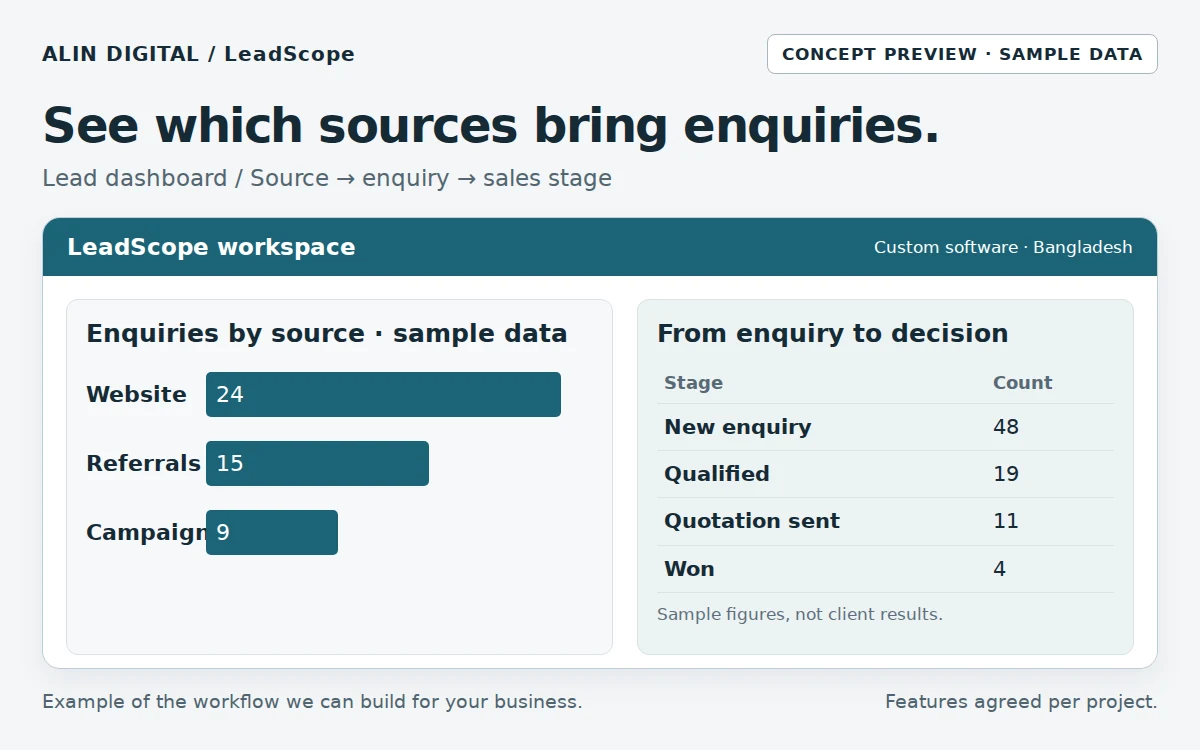
A dashboard is useful only when the team agrees what its numbers mean. An advertisement click, a WhatsApp button click, a genuine enquiry and a paying customer are different events. Counting them as the same conversion makes marketing look stronger than the sales pipeline. For a Bangladesh agency or local service business, build a small measurement dictionary before designing charts. Record the event, its source, its owner and when it is considered valid.
A familiar situation: illustrative example
Imagine a campaign gets many WhatsApp clicks, but the team receives very few relevant questions. The dashboard should reveal that gap so the offer or audience can be reviewed. It should not celebrate all clicks as customers.
Design the workflow before the interface
Connect the advertising view to the lead workflow using stable identifiers where practical. Preserve campaign tags, but do not put names, telephone numbers or email addresses in analytics event parameters. A customer may discover a business through one channel and return through another, so the dashboard should explain attribution limits rather than promise a perfect source for every sale.
Test the exceptions and boundaries
Use explicitly labelled example arithmetic when planning targets. If an assumed campaign spend is BDT 10,000 and it produces 20 verified enquiries, the example cost per enquiry is BDT 500. That is a calculation, not a market benchmark or forecast. Add service fees and other costs when assessing total acquisition economics; avoid hiding them inside an attractive advertising-only number.
Choose the smallest workable solution
Reconcile a sample every week: open the source form or CRM record and compare it with the dashboard. Track missing campaign information, duplicates and delayed sales updates. Stop using a metric for budget decisions if its definition or data feed is broken. A small report with honest gaps is more useful than a colourful dashboard with false precision.
A practical workflow
- Define business events
- Capture allowed campaign information
- Deduplicate verified enquiries
- Match outcomes with the sales team
- Review spend and qualified results
Acceptance checks before handover
Test a normal transaction, invalid input, a repeated request and an account without permission using representative business data. Check the agreed export. Write down account ownership, hosting responsibility, backup arrangements and the support route. Use test data before importing real customer records.
What to measure
Qualified enquiries; total acquisition cost; duplicate rate; missing source data. Record a baseline before launch and review the pilot against it. Software cannot guarantee improvement if the operating process and ownership remain unclear.
What the proposal should include
Separate features, users, imports, integrations, training and support in the quote. Ask for a BDT proposal and confirm whether hosting, API usage and third-party subscriptions are included. Custom development is different from subscribing to an existing SaaS product. Agree delivery dates after discovery and technical checks; unresolved integrations make fixed promises unreliable.
Common questions
Do we need every feature in the first release?
No. Start with one complete, testable workflow. Add modules after real usage shows what is missing.
Can the business move its data later?
Agree export formats, file access and account ownership in the proposal, then open an actual export during acceptance.
Further reading and next step
Compare the service with your workflow: LeadScope · Sales dashboard · Software catalogue · Discuss the project.