
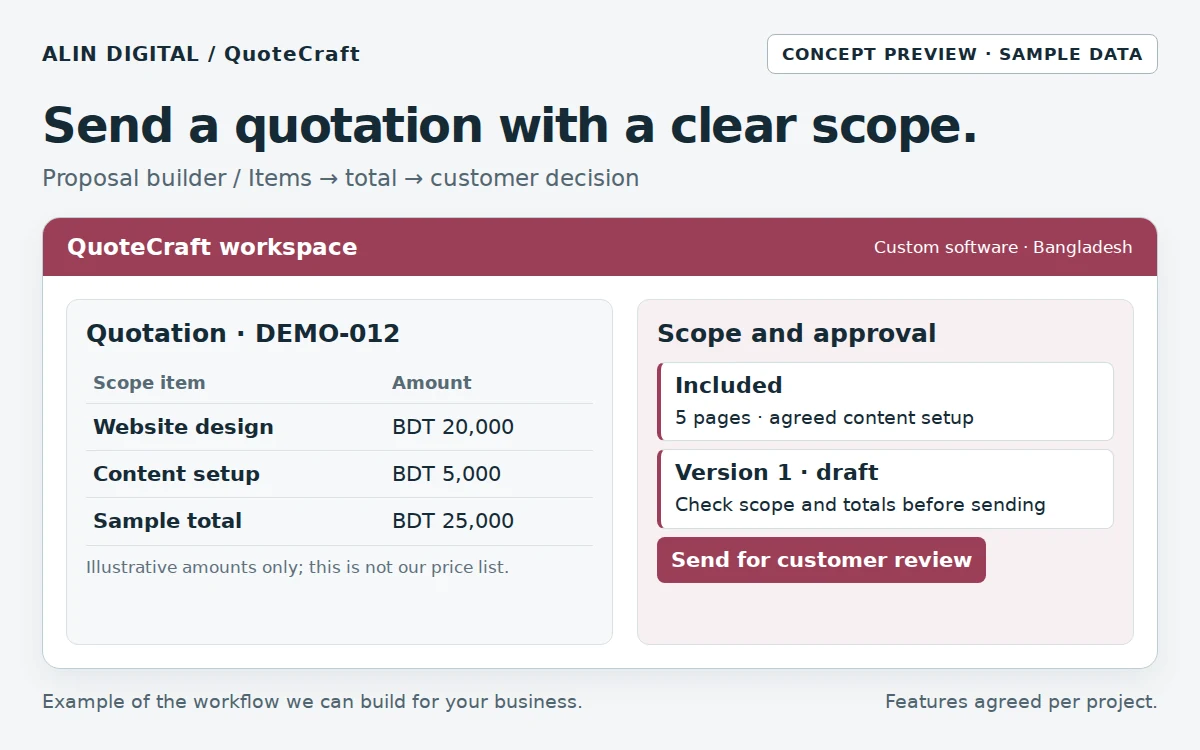
A quotation should explain what the customer is buying, what remains outside the price and how the work will be accepted. A PDF with an attractive total but unclear scope creates avoidable disputes. For a Bangladesh service agency, separate the service fee from advertising spend, hosting, subscriptions and other third-party costs. State any applicable tax treatment accurately for the transaction, with professional advice where necessary; software should not invent a tax rule.
A familiar situation: illustrative example
Imagine a customer accepts a proposal and later discovers advertising spend was excluded. A quotation tool should make that exclusion clear before acceptance. A polished PDF alone would not prevent the misunderstanding.
Design the workflow before the interface
Build a catalogue of reusable line items with editable descriptions and exclusions. Keep the quoted version separate from the current catalogue price; changing the catalogue must not silently rewrite an old proposal. Define validity, milestones, revision limits and the approval route. Allow an authorised person to correct a quote while preserving its history.
Test the exceptions and boundaries
Use a calculation test set before launch. Include a zero-discount quote, a percentage discount, a fixed discount, decimal quantities and a cancelled line. Check rounding and totals independently. If the application includes tax fields, test the agreed configuration with the responsible finance person instead of assuming a generic template suits every business.
Choose the smallest workable solution
Keep “sent”, “viewed”, “accepted” and “paid” distinct. A client opening a link is not acceptance, and acceptance is not payment. Agree whether a signature workflow is required and obtain appropriate advice if legal enforceability is material. A simple quote tool can prepare clear proposals without claiming to replace contracts or accounting software.
A practical workflow
- Choose approved line items
- Define scope, exclusions and validity
- Verify calculations and versions
- Send a clear proposal
- Record the actual decision
Acceptance checks before handover
Test a normal transaction, invalid input, a repeated request and an account without permission using representative business data. Check the agreed export. Write down account ownership, hosting responsibility, backup arrangements and the support route. Use test data before importing real customer records.
What to measure
Quote preparation time; calculation errors; clarification requests; acceptance status. Record a baseline before launch and review the pilot against it. Software cannot guarantee improvement if the operating process and ownership remain unclear.
What the proposal should include
Separate features, users, imports, integrations, training and support in the quote. Ask for a BDT proposal and confirm whether hosting, API usage and third-party subscriptions are included. Custom development is different from subscribing to an existing SaaS product. Agree delivery dates after discovery and technical checks; unresolved integrations make fixed promises unreliable.
Common questions
Do we need every feature in the first release?
No. Start with one complete, testable workflow. Add modules after real usage shows what is missing.
Can the business move its data later?
Agree export formats, file access and account ownership in the proposal, then open an actual export during acceptance.
Further reading and next step
Compare the service with your workflow: QuoteCraft · Quotes and proposals · Software catalogue · Discuss the project.