
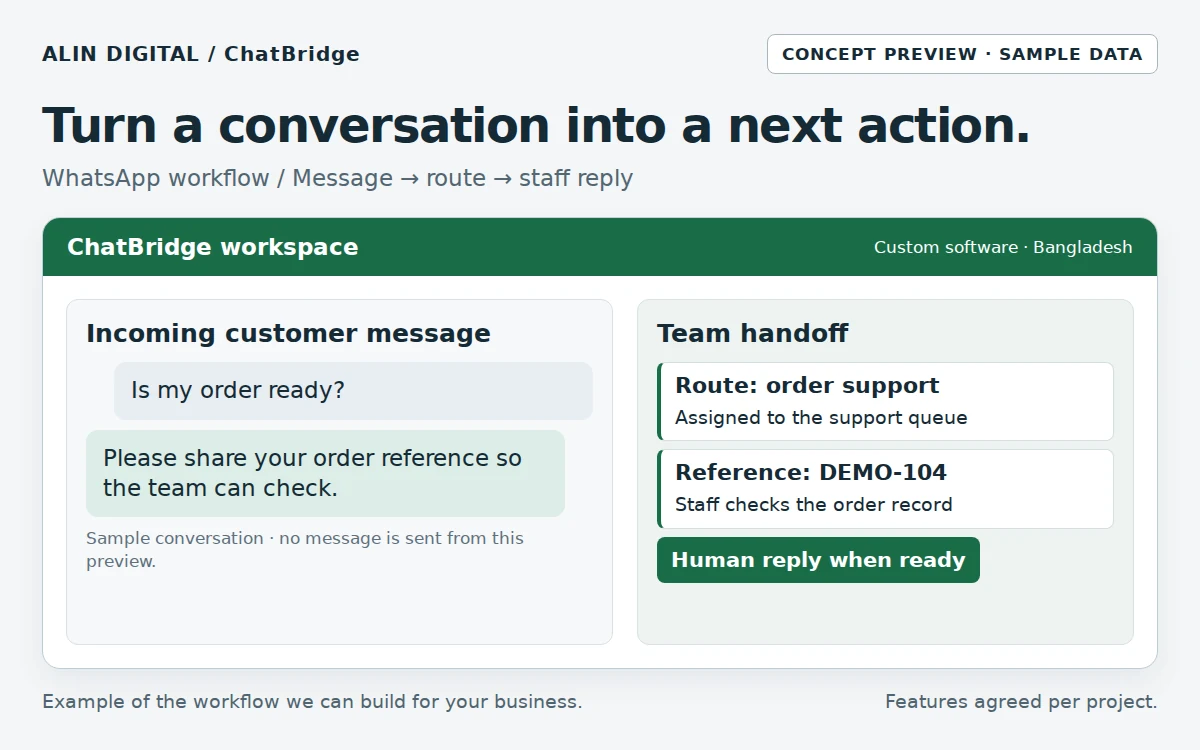
A shared inbox and a clear follow-up rule often solve more problems than a large chatbot. First identify why customers contact the business: product availability, service quotations, delivery questions or appointment changes. Each intent needs a sensible next step and an owner. Automation should acknowledge the request, collect a small amount of useful context and route it. It should never disguise a marketing broadcast as a personal reply.
A familiar situation: illustrative example
Imagine a customer asks about delivery and the message sits in a salesperson’s personal inbox. A simple routing rule can pass it to the right person with context. Sending more automated messages would not fix the ownership gap.
Design the workflow before the interface
Separate a click-to-chat link, the WhatsApp Business app and an API integration. They have different capabilities and setup requirements. Explain which option is being proposed before charging for automation. If the plan uses an API provider, confirm account ownership, supported message types, current charges and provider responsibilities in the proposal.
Test the exceptions and boundaries
Keep evidence that a customer expects the kind of messages you send, and honour stop requests. Check the current WhatsApp Business policies before launch because messaging eligibility and template rules can change. Do not promise that every message will be delivered, read or approved. Avoid buying scraped contact lists as a shortcut to a sales pipeline.
Choose the smallest workable solution
Design the human handoff before writing the automation. The staff member should receive the customer’s question, relevant reference and what the bot already said. Give customers a clear route to a person. Test after-hours messages, duplicate requests, an unsupported question and a failed provider request. A failure should not generate repeated messages or silently lose the enquiry.
A practical workflow
- Record the customer request
- Confirm expected communication
- Tag the topic and route the owner
- Answer from approved information
- Stop or hand off when needed
Acceptance checks before handover
Test a normal transaction, invalid input, a repeated request and an account without permission using representative business data. Check the agreed export. Write down account ownership, hosting responsibility, backup arrangements and the support route. Use test data before importing real customer records.
What to measure
Response time; unresolved conversations; opt-outs; failed sends. Record a baseline before launch and review the pilot against it. Software cannot guarantee improvement if the operating process and ownership remain unclear.
What the proposal should include
Separate features, users, imports, integrations, training and support in the quote. Ask for a BDT proposal and confirm whether hosting, API usage and third-party subscriptions are included. Custom development is different from subscribing to an existing SaaS product. Agree delivery dates after discovery and technical checks; unresolved integrations make fixed promises unreliable.
Common questions
Do we need every feature in the first release?
No. Start with one complete, testable workflow. Add modules after real usage shows what is missing.
Can the business move its data later?
Agree export formats, file access and account ownership in the proposal, then open an actual export during acceptance.
Further reading and next step
Compare the service with your workflow: ChatBridge · WhatsApp workflows · Software catalogue · Discuss the project.