
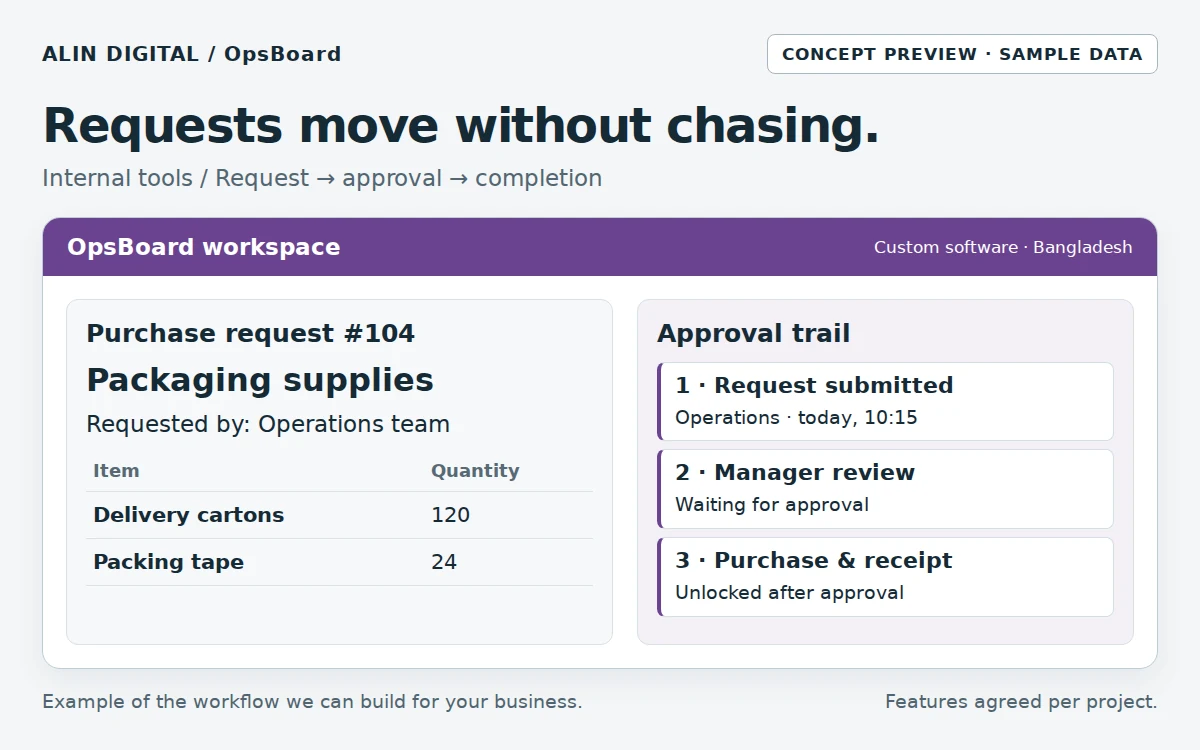
A spreadsheet becomes fragile when several people change the same status, copy rows into separate files and ask in chat which version is correct. That is a workflow problem rather than proof that the business needs a full ERP. Choose one recurring process with a clear start and finish: an expense request, a delivery checklist, a content approval or a service job. An internal tool should remove repeated coordination work while preserving a simple way to correct mistakes.
A familiar situation: illustrative example
Imagine an office where an expense request passes through three private messages. The applicant keeps asking who has it. A shared status and a reason when something is returned can be more useful than a large management dashboard.
Design the workflow before the interface
Map the current process with the staff who perform it, not only the person buying software. List inputs, decisions and exceptions. If a request can be returned for correction, include that state. If the approver is absent, define a substitute. A beautiful dashboard that cannot handle these ordinary exceptions will push work back into private messages.
Test the exceptions and boundaries
Use the smallest useful data model: request number, requester, category, supporting note, current owner, status and timestamps. Keep a change history for important decisions. Avoid uploading sensitive documents unless the workflow requires them and access has been agreed. Exported files need the same care as records inside the application.
Choose the smallest workable solution
Pilot with one team and compare a normal working week before and after. Count requests completed, avoidable re-entry and unresolved exceptions. Do not call the project successful because the software was delivered. Success means staff can complete the workflow and management can recover its records if the supplier changes.
A practical workflow
- Submit a structured request
- Validate the required details
- Approve or return with a reason
- Complete the action
- Export and review the audit trail
Acceptance checks before handover
Test a normal transaction, invalid input, a repeated request and an account without permission using representative business data. Check the agreed export. Write down account ownership, hosting responsibility, backup arrangements and the support route. Use test data before importing real customer records.
What to measure
Completion time; re-entry count; unresolved exceptions; staff adoption. Record a baseline before launch and review the pilot against it. Software cannot guarantee improvement if the operating process and ownership remain unclear.
What the proposal should include
Separate features, users, imports, integrations, training and support in the quote. Ask for a BDT proposal and confirm whether hosting, API usage and third-party subscriptions are included. Custom development is different from subscribing to an existing SaaS product. Agree delivery dates after discovery and technical checks; unresolved integrations make fixed promises unreliable.
Common questions
Do we need every feature in the first release?
No. Start with one complete, testable workflow. Add modules after real usage shows what is missing.
Can the business move its data later?
Agree export formats, file access and account ownership in the proposal, then open an actual export during acceptance.
Further reading and next step
Compare the service with your workflow: OpsBoard · Internal tools · Software catalogue · Discuss the project.